[INGLÉS] From Quito to Ulaanbaatar – Latin America advocacy brief on Grasslands and Savannas
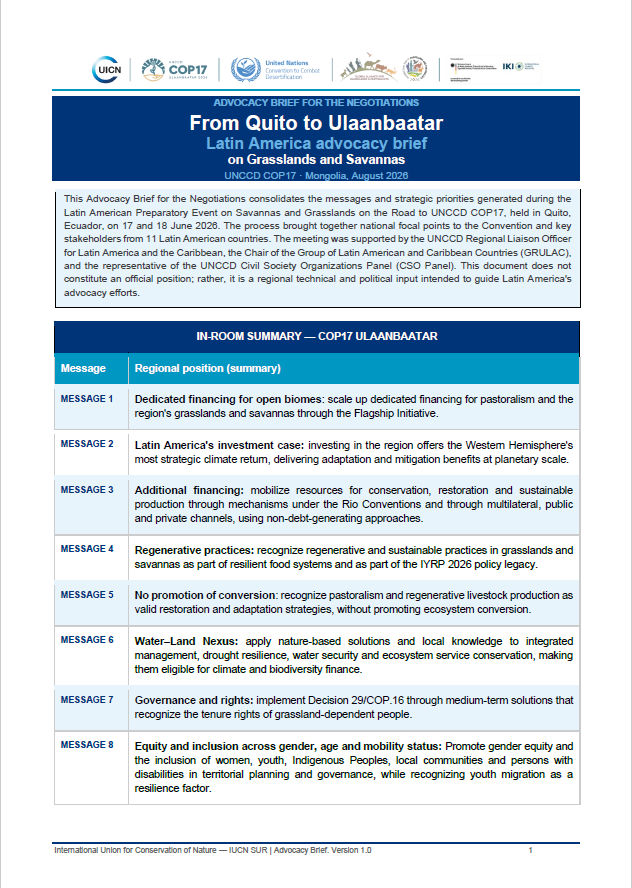
This Advocacy Brief for the Negotiations consolidates the messages and strategic priorities generated during the Latin American Preparatory Event on Savannas and Grasslands on the Road to UNCCD COP17, held in Quito, Ecuador, on 17 and 18 June 2026. The process brought together national focal points to the Convention and key stakeholders from 11 Latin American countries. The meeting was supported by the UNCCD Regional Liaison Officer for Latin America and the Caribbean, the Chair of the Group of Latin American and Caribbean Countries (GRULAC), and the representative of the UNCCD Civil Society Organizations Panel (CSO Panel). This document does not constitute an official position; rather, it is a regional technical and political input intended to guide Latin America’s advocacy efforts
 Ver todos los recursos
Detalle
Executive summary and strategic context
2026 is the Triple COP Year: UNCCD COP17 in Ulaanbaatar, Mongolia, opens an unprecedented sequence that continues with CBD COP17 in Yerevan, Armenia, and concludes with UNFCCC COP31 in Antalya, Türkiye. This alignment represents the decade’s greatest political opportunity to integrate the three Rio Conventions, and Latin America must arrive in Mongolia with that ambition clearly articulated.
Latin America will arrive at COP17 with a clear position: grasslands and savannas are not marginal lands, but ecological infrastructure that underpins water security, food sovereignty and climate stability for more than 30 million people. These biomes cover 18% of the region’s territory — equivalent to more than one third of the continent’s productive land — and store up to 90% of their carbon below ground. Yet only 10% of NDCs mention them, compared with 70% that include forests (WWF, 2025). This structural gap constrains financing, leaves the biome invisible in reporting systems and marginalizes the people who depend on it.
The political‑legal basis for advocacy is solid: Decision 29/COP.16 from Riyadh, Saudi Arabia, requires the formal protection of rangelands; Resolutions 019, 095 and 116 adopted at the IUCN World Conservation Congress (Marseille, 2021) call for halting the conversion of open ecosystems; the GRaSS Global Alliance, co-led by IUCN and WWF, serves as a vehicle for international negotiation; and the MOU signed between IUCN and the Government of Mongolia at the 2025 IUCN World Conservation Congress opens a direct diplomatic channel with the COP17 Presidency that should be leveraged.
The region arrives in Mongolia with a concrete objective: to secure explicit mention of Latin America’s grasslands and savannas in the Steppe Action Agenda, the COP17 legacy framework Mongolia is advancing to sustain political momentum beyond the conference. This objective is linked to the region’s priorities of securing recognition in the Flagship Initiative with dedicated financing, operationalizing Decision 29/COP.16 with resources and methodological guidance, advancing effective synergies across NAPs, NDCs and the GBF within the Triple COP 2026 framework, promoting nature-based solutions in the integrated management of grasslands and savannas, and ensuring sustainable production without promoting the conversion of these ecosystems.
País(es) de enfoque
Tipo de recurso
Ecosistema
Temática principal
Descarga del recurso
¿Tienes preguntas o aportes?
Si necesitas orientación sobre este Recurso
Sobre el autor del Recurso